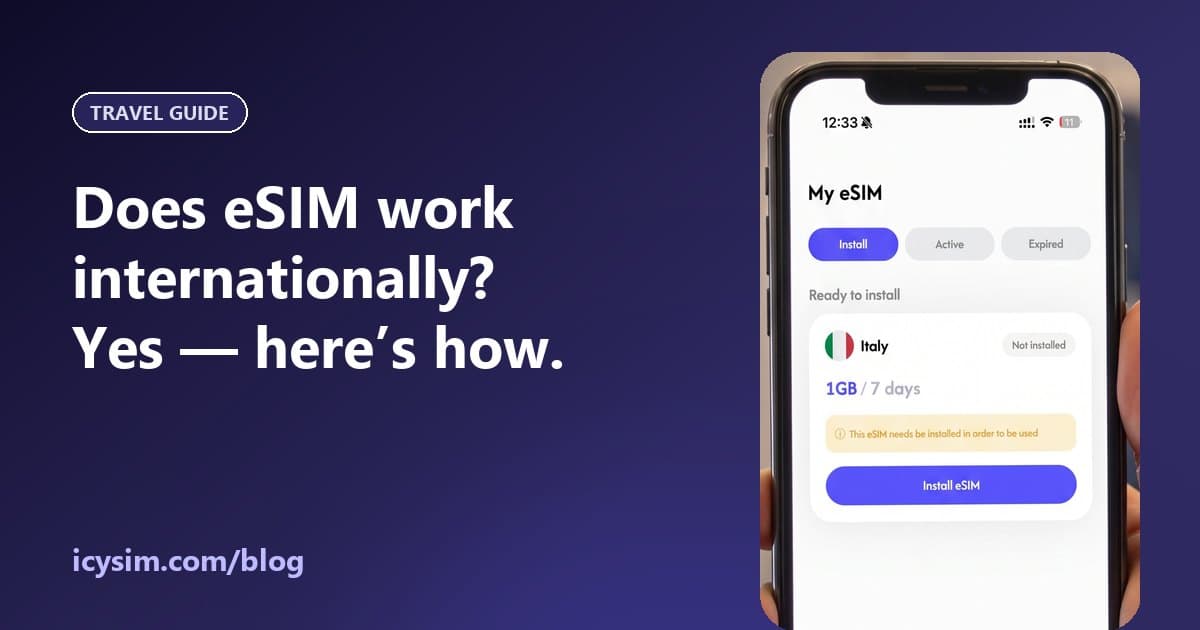


Yes — a travel eSIM works in the Dominican Republic, and ours connects to Claro, the country’s largest network. It’s the easiest way to stay connected outside the resort: no SIM shop, no ID paperwork (local SIMs now need a passport and photo), and you’re online the moment you land in Punta Cana.
- Our Dominican Republic eSIM uses Claro, with about 64% of the country’s mobile lines.
- Since 2025, local prepaid SIMs need a passport and a photo; unverified lines get suspended.
- Punta Cana (PUJ) is by far the busiest airport — install your eSIM before you fly.
- Resort Wi-Fi covers the hotel, but not excursions, taxis and town — that’s where data matters.
- Coverage is good in resort areas and cities; inland mountains can drop to weak signal.
Which networks will your eSIM use?
The Dominican Republic has three operators. At the end of 2025, regulator data put Claro at about 64% of mobile lines, Altice at about 34% and Viva at around 3%. Our Dominican Republic eSIM connects to Claro, which is also the network most often recommended for coverage outside the resort strips.
The 2025 SIM ID rules
Under Indotel Resolution 064-2025, prepaid SIMs can only be sold with a valid ID — for visitors, a passport — plus a photo of the buyer, and lines that aren’t validated are suspended and then cancelled. A travel eSIM bought online skips that process entirely.
Arriving: Punta Cana, Santo Domingo, Puerto Plata
Punta Cana (PUJ) handled more than 11 million passengers in 2025 — over half of all international arrivals — followed by Santo Domingo Las Américas (SDQ) and Puerto Plata (POP). Whether PUJ has carrier counters is unclear (reports conflict), and airport Wi-Fi is slow and time-limited, so the simplest plan is an eSIM installed at home: switch it on as you land and message your transfer or hotel straight away.
Is resort Wi-Fi enough?
If you’re staying a few nights and never leaving the resort, maybe. But resort Wi-Fi often doesn’t reach the beach or pool, and it’s no help on excursions, in taxis or in town — exactly when you need maps, translation or to reach your group. A small eSIM plan covers those moments without roaming charges from home.
Coverage on excursions
- Punta Cana / Bávaro, Puerto Plata, Santo Domingo: good coverage in resort areas and cities.
- Saona Island and boat trips: signal is strong at the Bayahibe departure point and varies on the island and at sea.
- Samaná Peninsula: generally good along the coast.
- Inland and mountain areas (e.g. around Jarabacoa): can drop to weak signal or dead zones — download offline maps.

eSIM vs your home carrier’s roaming
Many US plans charge a daily fee in the Dominican Republic — AT&T’s International Day Pass, for example, is $12 a day (billed for up to 10 days per cycle). On a week-long trip, a prepaid eSIM is usually much cheaper. Our Dominican Republic plans start at $3 for 1 GB (7 days) — see the live Dominican Republic page for current prices (checked 9 October 2026).
Set up your eSIM
- Buy a Dominican Republic plan — or a Caribbean plan if you’re island-hopping.
- Install it at home on Wi-Fi; validity starts when you first use data.
- When you land, set the eSIM as your mobile data line and turn on data roaming for it.
- Keep your home SIM on for calls and SMS codes, with its data roaming off.
Heading to the Dominican Republic?
Dominican Republic eSIM on Claro — online the moment you land in Punta Cana.
See Dominican Republic plans →