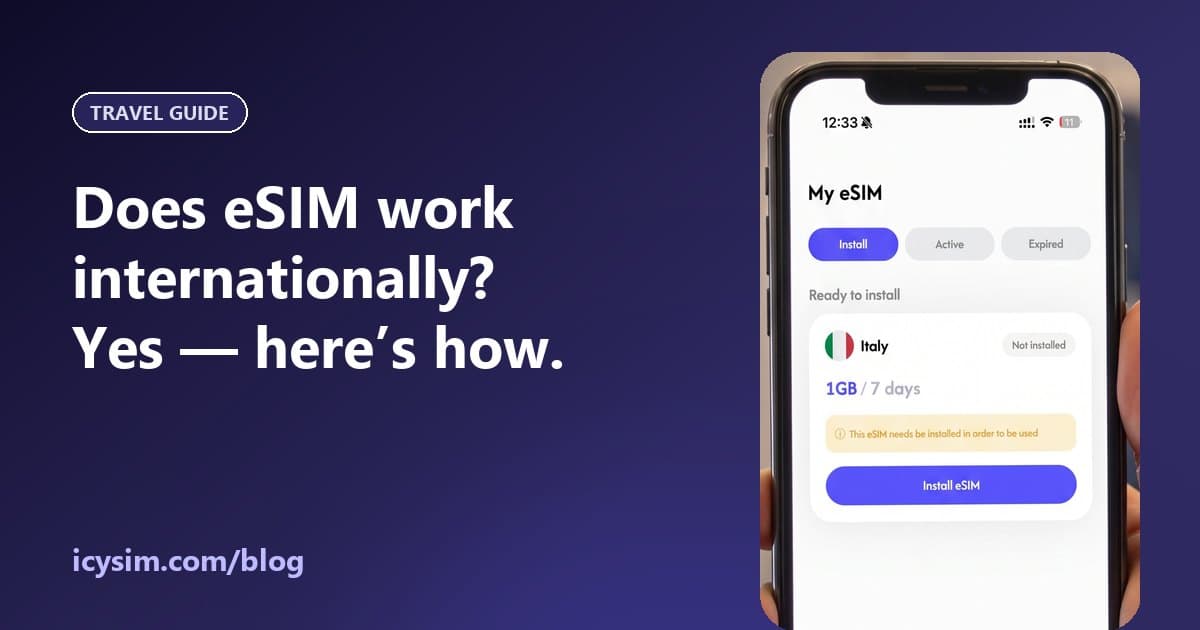


Yes — an eSIM works in roaming exactly like a physical SIM. If your home line is an eSIM, it will roam abroad on your carrier’s partner networks and you’ll pay your carrier’s roaming prices. If you add a travel eSIM, you turn data roaming on for the travel eSIM (it’s already paid for) and off for your home line, so you don’t get charged twice.
- “eSIM” is just the format — roaming works the same as with a SIM card, at the same prices.
- Home carrier roaming usually costs a daily fee abroad: about $12 a day on AT&T or Verizon, £2.75 a day in Europe on Vodafone or Three, C$16–18 a day on Canadian carriers.
- With a travel eSIM, data roaming must be on for that line — that’s how it connects — and it costs nothing extra.
- Keep data roaming off on your home line so it can’t run up charges; calls and texts still work.
- On iOS 26 you can pick Travel eSIM Only or Travel eSIM and Current eSIM when you add a travel eSIM.
Will an eSIM work in roaming?
Yes. An eSIM is a SIM built into your phone — the network sees the same thing it would see from a plastic card. So if your home line is an eSIM, it will connect abroad through your carrier’s roaming partners, exactly as a physical SIM would. Apple puts it plainly: international roaming with an eSIM works the same as with a physical SIM. What changes the bill is which line you use for data abroad, not the SIM format.
| Home line roaming | Travel eSIM | |
|---|---|---|
| Who you pay | Your home carrier | The travel eSIM provider, upfront |
| Typical price | Daily pass or per-MB fees | One prepaid price per plan |
| Your number | Works for calls and texts | Home number still works on the other line |
| Data roaming switch | On = you may be charged | Must be on — it’s already paid for |
| Risk of a surprise bill | Yes, if you forget | No — when the data runs out, it stops |
What does roaming cost on your home plan?
Most carriers charge a fee for each day you use your phone abroad. Here’s what the big carriers listed on their own websites when we checked on 12 October 2026:
| Carrier | Roaming price | Notes |
|---|---|---|
| AT&T (US) | $12 a day (International Day Pass) | Extra lines $6/day; Mexico and Canada included on eligible Unlimited plans; pay-per-use data $2.05 per MB |
| Verizon (US) | $12 a day per line (TravelPass) | $6/day in Canada and Mexico; 5 GB high-speed per day, then 3G speeds |
| T-Mobile (US) | Depends on plan | Experience plans include 5–15 GB high-speed abroad, then slow data; Essentials has no included data |
| Vodafone (UK) | £2.75 a day in Europe | £8 a day in further zones (from April 2026) |
| Three (UK) | £2.75 a day in Europe | £8 a day elsewhere, for plans started from 18 Dec 2025; older plans £2 / £7 |
| O2 (UK) | Europe included in plans | Up to 25 GB in Europe; Travel Bolt On £7 a day elsewhere |
| Bell (Canada) | C$13/day US, C$16/day international | 5 GB a day at full speed |
| TELUS (Canada) | C$16/day US, C$18/day international | Raised in October 2025 |
| Rogers (Canada) | C$16 a day in the US | Travel passes also sold |
| Telstra (Australia) | A$10 a day with 2 GB | A$5 a day in NZ and some Pacific destinations |
So a week abroad on your home line typically costs $84 on AT&T or Verizon, about £19 in Europe on Vodafone or Three, or C$112–126 on Canadian carriers — and the daily allowances can run out. A travel eSIM for the same week is often under $10. If you live in the EU and travel inside the EU/EEA, “Roam like at home” means no roaming charges at all (the rules now run until 2032) — but it doesn’t cover the UK or anywhere outside Europe.

Should data roaming be on or off with an eSIM?
It depends on the line. On for the travel eSIM: travel eSIMs connect through partner networks in your destination, which your phone treats as roaming — with roaming off, it won’t connect. That costs nothing extra because you paid for the plan. Off for your home line: that’s the line your carrier can charge for. Your home number still receives calls and texts (including bank codes) with its data roaming off — though your carrier may charge for calls you answer abroad.
On iPhone, also turn off Allow Cellular Data Switching (under Cellular Data) — when it’s on, the phone may use data from either line depending on coverage, and you want data to stay on the travel eSIM. On iOS 26 and later, when you add a travel eSIM you can choose Travel eSIM Only or Travel eSIM and Current eSIM; if you keep both, the travel eSIM handles data.
Using your home eSIM abroad: when it makes sense
Sometimes your home plan is the better deal: if you’re an EU resident travelling in the EU/EEA (Roam like at home), on O2 in Europe, on a US plan that includes Mexico and Canada, or on a plan with roaming data included and you only need a little. It’s also simplest for a single day — one daily pass is fine for a day trip. Beyond two or three days, daily fees add up fast, and that’s where a prepaid travel eSIM is cheaper.
How a travel eSIM avoids roaming charges
A travel eSIM is a second line that you buy for your destination. You pay once — for example 5 GB for 30 days in Japan, France or Thailand for $6 on our destination pages (12 October 2026) — and when the data runs out, it simply stops; there’s no bill afterwards. Your home line stays in the phone for calls and texts. Not sure your phone can hold two lines? Check compatibility.
Set up a travel eSIM so roaming works
- Install the travel eSIM at home on Wi-Fi (most plans start counting on first use).
- Label the lines — e.g. “Home” and “Travel” — so the settings are easy to tell apart.
- When you land, set Travel as the mobile data line.
- Turn data roaming on for Travel and off for Home.
- Turn off Allow Cellular Data Switching (iPhone).
- Test: open a map. If nothing loads, restart the phone and check roaming is on for the travel line.
Roaming on cruises and planes

Ships and planes use satellite or maritime networks that normal roaming deals don’t cover. The EU says these networks are not subject to its roaming price caps; EU operators must text you when you connect and cut service at €50 of charges unless you opt out. Outside the EU there may be no cap at all — AT&T, for example, lists pay-per-use data at $2.05 per MB on cruise ships and airlines, or $20 a day for a cruise Day Pass. A travel eSIM doesn’t work at sea either, so keep your home line’s roaming off (or use flight mode with Wi-Fi) until you reach port; then the travel eSIM reconnects to the local network if your plan covers that country.
eSIM not working in roaming? Check these
- Data roaming is off on the travel eSIM — the most common cause.
- Wrong data line selected — your phone is still using the home line.
- The plan hasn’t started or covers a different country — check the app.
- Network selection: switch from automatic to a listed partner network (the destination page lists them).
- Restart the phone after landing; it often fixes the first connection.
Skip the roaming bill
Prepaid travel eSIMs for 190+ destinations — install before you fly, no daily fees.
Find your destination →